Thursday, January 26, 2012

A museum in Spearfish's future?

There have long been rumblings about a local museum for Spearfish.

And it seems the topic is beginning to catch on with citizens from different parts of the community.

At the November meeting of the Spearfish Area Historical Society board of directors, there was preliminary discussion about the virtues and the challenges of starting a museum that is dedicated to things relating to the rich history of Spearfish.  While there was no definitive action taken, members agreed to share thoughts on the idea, and at least begin a dialogue on the topic.

Then councilman Doug Schmit led a discussion at the December 19, 2011 meeting of the Spearfish City Council regarding the need to find a place to "consolidate and keep them."  He expressed a desire to visit with the historical society about its willingness and ability to take on the task of assembling and displaying items in a museum.  He suggested that the basement of city hall might be an ideal temporary location until a permanent site can be found.

With that in mind, Schmit and City Administrator Joe Neeb has scheduled a public roundtable regarding a possible museum.  It will be at 6:00 p.m. next Monday evening, January 30th, in the council chambers at City Hall.  Interested persons are encouraged to attend

Tuesday, January 10, 2012

Davis busy on speaking trail

LCHS life member Vernon Davis has been a busy man for the past few weeks, speaking before a couple of audiences in Lawrence and Butte counties.

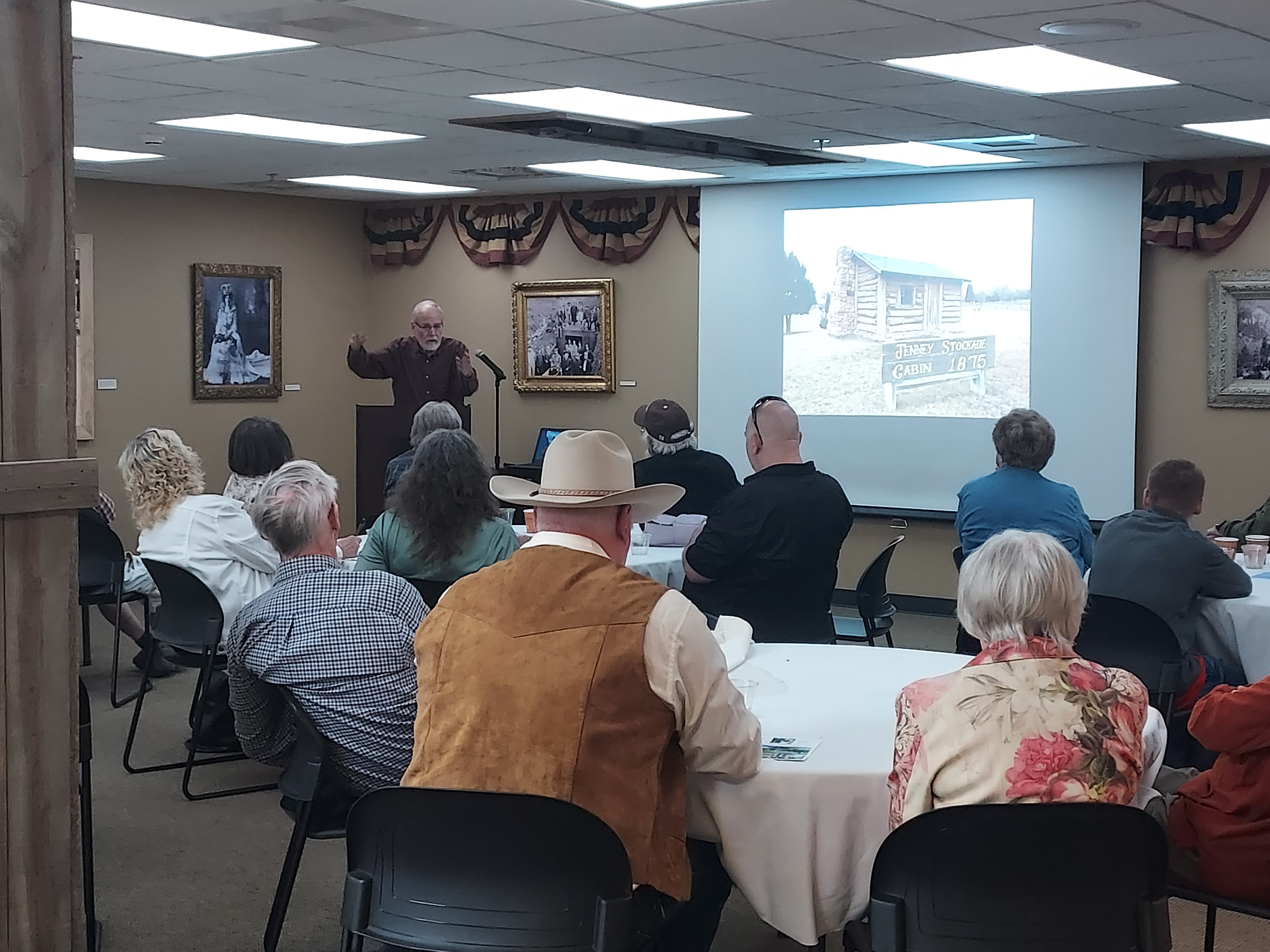
On January 3rd, Davis spoke to about 75 members of the Spearfish Area Historical Society in Spearfish about his great uncle, "Buckskin" Johnny Spaulding, who was a key figure in the history surrounding the old Spearfish stockade.  It was just one of many chapters of history about Spaulding, who was among early pioneers in this region of South Dakota.

Then on January 7th, Davis was on the speaking circuit again -- albeit to a somewhat smaller group -- regarding cemetery preservation.

You can read more about his cemetery presentation in Belle Fourche by simply clicking on this link to the online Butte County Post.

Wednesday, December 28, 2011

Case Library at Black Hills State University

A few weeks ago, the Friends of Case Library at Black Hills State University distributed the fall edition of "The Black Hills Historian."  It contains several interesting pieces, including an abbreviated version of the Johnson Siding story that we posted here last week.  The newsletter also offers a variety of helpful tips, including a "Highlighted Resource," which this time focuses upon Lawrence County tax records.  Well worth a visit.  There's also a feature called "Highlighted Collection," which for this issue is described in the article below by Dr. David Wolff and Roberta Sago.  Our thanks to both of them for allowing us to re-print their article here.

 Highlighted Collection:  
Wharf/Bald Mountain Mining Records

The records donated by the Wharf Mining Company deal primarily with the Bald Mountain Mining Company (BMMC), which was organized in 1928 and operated intermittently in the Bald Mountain/Terry Peak areas until 1959. While the company was a late arrival in terms of Black Hills mining history, the ground it worked had been prospected and developed since 1877. In that year, A.J. Smith located the claims that eventually became part of the Bald Mountain Mining Company.

The first actual mining company to precede the BMMC was the Portland Mining Co., organized in 1880, but its production was limited because of difficulties in treating the area’s refractory gold ore. In 1911 the Portland Company purchased the American Eagle Mining Co., including its cyanide mill, and the property was reorganized as the Trojan Mining Co. From that time until 1923, the Trojan company produced about 300,000 ounces of gold. Rising costs caused this company to close, and the property underwent another reorganization, this time as the Bald Mountain Mining Co.  

The new entity did some exploration, but actual production did not begin until 1933 when the government raised the price of gold to $35 an ounce. The increase allowed the company to do well, but only for a time. With the price of gold fixed at $35 an ounce through the 1950s, profits disappeared and the operation closed. The Wharf took control of the property in the 1980s when the federal government stopped regulating the price of gold, and mining again became profitable.

The Wharf Records collection consists of 10.5 cubic feet or records and more than 1,000 mining maps and blueprints.  Materials are dated from 1893-1960 and include:  Balance Sheets1949-1954; Journal dated 1934-1958, recording ore mined, weight, dry, bullion, percent of water, percent of bullion; Invoices 1956-1958, detailing purchase Records, Stock Records of Equipment, List of and location of Equipment on property, Record  of Supplies Purchased from the Company by the miners; Information about other mining companies; BMMC Investigations into other types of ore; Mill performance data; Surveyor’s Log; General Assay Book; Test Notes; Oil Lands and Leases 1897-1920; Uranium, Uranium Mining 1953-1955, Uranium Legislation 1950-1955, Uranium Analysis 1953-1955; Advertising Pamphlets and catalogs; Information on and correspondence concerning new equipment 1934-1958; Personnel Records; Order book; Wage scale; Abstracts of Title; Shipment Statements; Purchase Orders; C.E. Dawson Correspondence, 1937-1948; Traverse Sheets; and Calculation Sheets.

Wharf Resources, Inc. donated these records in 1987.  You can search the inventory of the maps online at:

In addition to the materials donated in 1987, The City of Deadwood Archives donated 28 boxes of materials and nine ledgers to enhance the Wharf / Bald Mountain Mining Records collection.  These documents cover the company history from the 1930s to the 1950s.

NOTE:  Case Library is located on the second floor of the E.Y. Berry Library-Learning Center on the campus of Black Hills State University.  More information about the library can be found at:  Case Library.

Thursday, December 15, 2011

Johnson Siding...

A History of a Black Hills Sawmill

There are so many places across the region that have fascinating histories that it's hard to keep up with them.  And sometimes we drive right by familiar locations, not fully appreciating the history behind them.

Such is the case of Johnson Siding, nestled along South Dakota Highway 44 about 10 miles west of Rapid City.  Just over the county line in Pennington County, it's one of those places that we often hear about, perhaps frequently drive by, but without giving much thought to its history -- or how it got its name.

Fortunately, an Adjunct Instructor of History for Black Hills State University at the University Center in Rapid City has helped fill the void regarding Johnson Siding.

Erik Iverson researched and wrote the following article while enrolled in the Mountains of History (MOH) program supported by a grant from the U. S. Department of Education.  It was in collaboration with Black Hills State University, Mt. Rushmore National Memorial, the Chiesman Foundation, Crazy Horse Memorial, and Technology in Education (TIE) of Rapid City.  A resident of Rapid  City since 1984, Iverson graduated from Rapid City Central and earned a degree in Social Studies from Black Hills State University.  He has a Master's Degree in American History from Ashland University in Ohio and has taught in Rapid City Schools for 12 years.

Iverson's research into Johnson Siding is also a bit of family research.  His wife of nearly 20 years, Heidi, was a Johnson.  They have four children:  Emily, 14; Isaak, 11; Aaron, 9; and Aiden, 6. It was Heidi's great, great, grandfather Johnson whose name became indelibly linked to that special place called Johnson Siding.

Our thanks to Erik Johnson for allowing us to publish here his article entitled:


Saturday, December 10, 2011

A peek at early education in Deadwood

Jerry Bryant
Jerry Bryant, immediate past president of the Lawrence County Historical is a dogged researcher and frequent contributor to our on-line newsletter.

Jerry's latest initiative has been an examination of education in early Deadwood, and -- as usual -- he's found a bevy of interesting information that old-timers and newcomers alike will enjoy.  After poring through 10 years of archived copies of the Black Hills Pioneer and the Black Hills Times, Jerry offers a glimpse of early Deadwood schools -- and teachers.

Prominent among them was the lady Jerry identifies as the first public school teacher in Deadwood, Minnie Callison, whose early demise is described in Jerry Bryan's article. Click on the link below to read:

Sunday, November 13, 2011

Cerney tells about Black Hills fire towers


It was 100 years ago that the first fire rustic lookout was built in the Black Hills atop Harney Peak, the highest point between the Rocky Mountains and the European Alps.  The structure was quite modest when compared to the stone lookouts later erected by the Civilian Conservation Corps in the 1930’s.  By mid-Twentieth Century, steel towers had replaced many of the old wooden structures.

Author Jan Cerney (left) with
LCHS president Jeannine Guern
South Dakota author Jan Cerney shared a few photos and lots of facts about fire towers with members of the Lawrence County Historical Society on Sunday (11/13/11)  at the organization’s annual meeting in Deadwood.  The dinner session was held at the Homestake Adams Research and Cultural Center and was catered by the Stage Stop CafĂ© at Cheyenne Crossing.

Cerney’s presentation was largely based on a book about Harney Peak and the Historic Fire Lookout Towers of the Black Hills National Forest that she co-authored with Roberta Sago of Black Hills State University.   Cerney lives on a ranch with her husband, Bob, in the South Dakota Bad Lands.  Both Cerney and Sago have authored several books published by Arcadia, a leading publisher of local histories across the United States.

“Before they even began to construct towers, horses were used to patrol the area, and they’d have to ride a distance to report any fires,” said Cerney.

 Early lookout towers were quite humble, including those that were created simply by driving spikes into a tall tree, allowing a lookout to climb to a high vantage point to scan the region.  That was the simple strategy employed by the Homestake Mine lookout that was used near Moskee.  They later added a platform to the top.

This fire tower at Cement Ridge near the Wyoming-South Dakota border is one
of only a few such facilities that remain in operation across the Black Hills.
 “Most of the old towers that were built later have become hiking destinations – some are gone and totally destroyed – but a few are still used,” she noted.  They include structures at Mount Coolidge, Bear Mountain, Cement Ridge, Elk Mountain, and at Warren Peak in Wyoming.

“The Lakota called Harney Peak the center of the world,” Cerney told the group.  “Lakota leader Black Elk, his son Ben, poet John Neihardt and his daughters Enid and Hilda made a pilgrimage to Harney Peak back in 1931.”

Stage Coach Cafe at Cheyenne Crossing provided
a superb lunch for the annual meeting of the LCHS.
The next year, Neihardt and Black Elk collaborated on the book Black Elk Speaks, which told the story of Black Elk, a Lakota medicine man.

Cerney showed a few of the more than 200 photographs included in her book.   Today, perhaps the most recognizable remaining watch tower is the stone structure perched more than 7,200 feet above the Black Hills on Harney Peak.  It typifies the solid structures that were the handiwork of the CCC, which started building the tower in April of 1938.  By that November, they had used some 7,000 stones, 500 bricks, and 15,000 hollow tiles.  It was completed in 1939.

 The November 13th meeting served as the Annual Meeting for the Lawrence County Historical Society.  New officers were introduced, including Jeannine Guern of Deadwood, president; Norma Kraemer of Deadwood, vice-president; Jacke Mitchell of Spearfish, treasurer; and Donna Watson of Deadwood, secretary.  Members were delight to see Jerry Bryant and his wife, Linda, at this meeting.  Bryant had stepped down from the presidency earlier this year due to health reason.

You can review more photographs and additional information about the November meeting in our Historical Marker Gallery.